Commercial Radon Mitigation in Western Colorado

Schools, daycares, multifamily, offices, and clinics — we test and mitigate radon at commercial scale, then document that the building is under control. Built to AARST commercial standards.

Call (970) 639-7503
Free assessments · Property managers welcome · Ongoing monitoring available
Licensed Colorado Radon Pros
NRPP / AARST Standards
Results Guaranteed

Request a Commercial Radon Assessment

Tell us the building type and size and whether you have test data, and we'll scope a testing and mitigation plan. Call (970) 639-7503 or send the form.

  • Schools, daycares, multifamily, offices & clinics
  • Testing designed to ANSI/AARST commercial protocols
  • Ongoing monitoring and documentation available

Radon Is a Commercial Problem, Not Just a Home Problem

Radon doesn't care whether a building is a house or a 40,000-square-foot school — it comes from uranium in the soil beneath the foundation, and any occupied ground-contact space can accumulate it. That puts commercial buildings across Western Colorado squarely in the picture, because Mesa County sits in EPA Radon Zone 1, the highest of the three national zones, and roughly a third of the local buildings tested through the state program come back at or above the EPA action level of 4.0 pCi/L. Statewide, the Colorado Department of Public Health and Environment reports that about half of Colorado buildings test above that level.

For an owner, a property manager, or an administrator, the stakes are different than they are for a homeowner. You're responsible for the air a lot of people breathe for a lot of hours — children in a daycare or classroom, tenants in an apartment, staff at desks in a ground-floor office. Radon is the second-leading cause of lung cancer overall and the number one cause among people who have never smoked, and the risk rises with the level and the years of exposure. Getting a building tested and, if needed, mitigated is both an occupant-health measure and a documentation you can point to. We serve commercial clients throughout the Grand Valley and out across the Western Slope, from Grand Junction and Fruita to Delta and Montrose.

How Commercial Mitigation Differs From Residential

The underlying physics is the same as a house — put the soil under the slab at slightly lower pressure than the building so radon vents outside instead of rising indoors — but commercial work differs in scale, complexity, and coordination.
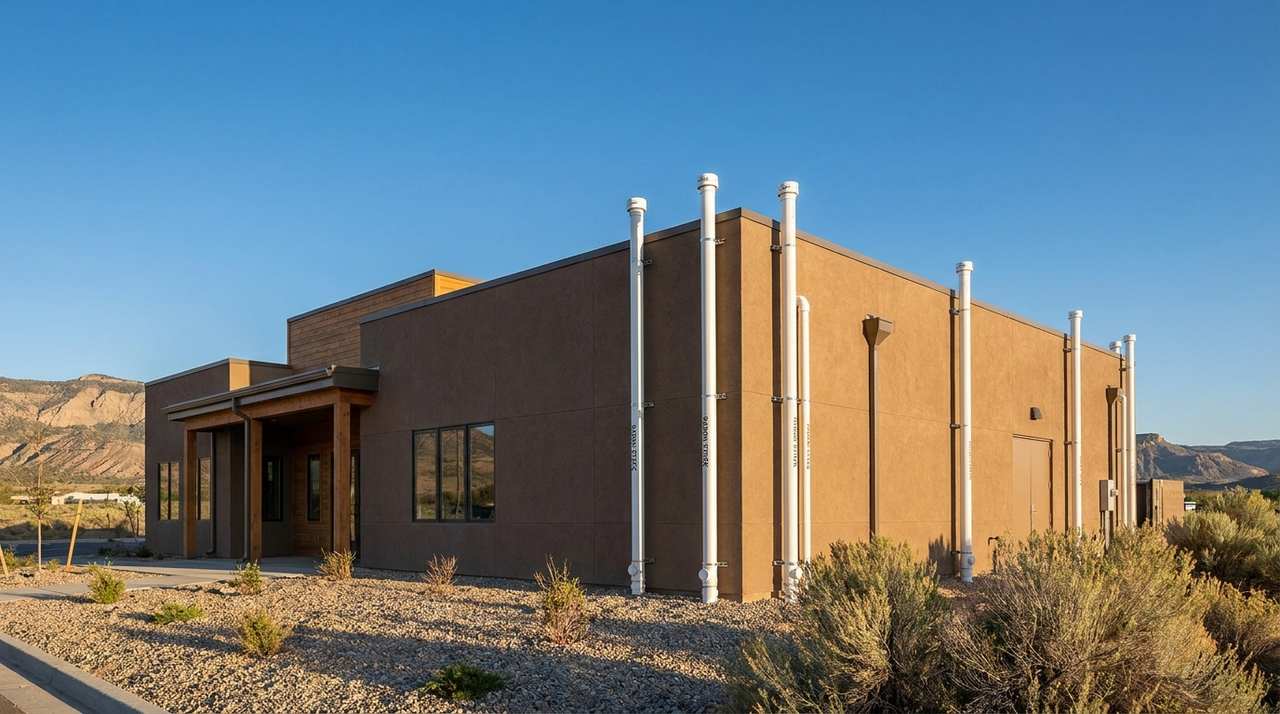
Commercial building exterior

Commercial systems account for factors a single-family home rarely raises:

That's why a commercial project starts with a proper assessment rather than a quick quote — the design has to fit the building.

Sub-Slab Depressurization and Soil-Gas Control at Scale

For most commercial buildings the solution is active sub-slab depressurization engineered for the footprint: a network of suction points cored through the slab, connected by sealed piping to commercial-grade fans that vent soil gas above the roofline. On a large slab, sub-slab communication — how freely air moves under the concrete — varies from one area to another, so we run diagnostics to place suction points where they'll actually reach, rather than guessing. Interior slab penetrations, expansion joints, utility chases, and sumps get sealed so the fans pull from the ground instead of the conditioned air inside.

The result is a soil-gas control system sized to the building: enough suction to hold the entire ground-contact area at negative pressure, balanced so no zone is left behind, and vented safely away from air intakes and occupied areas. Each system is verified by post-mitigation testing across the building, not a single reading, so the documentation reflects the whole floor. For phased or very large facilities we can design in stages, and we coordinate permitting through Mesa County or the City of Grand Junction as the work requires.

Testing and Ongoing Monitoring (OM&M)

Commercial radon isn't a one-and-done reading — it's an ongoing responsibility, and the AARST framework treats it that way through operation, maintenance, and monitoring (OM&M). Testing comes first: rather than a single device in one room, a commercial test places devices across a representative set of ground-contact spaces, accounts for how the HVAC system moves air, and runs over a defined period so the data reflects real occupancy. In a school or multifamily building, that might mean many devices and a documented plan.

Once a system is in, monitoring keeps it honest. Fans wear, buildings change, and renovations or HVAC adjustments can shift pressures, so we set up periodic re-testing and system checks appropriate to the building. For owners and administrators, that ongoing record is exactly what boards, licensing bodies, and prospective tenants want to see: proof that radon is measured, controlled, and maintained — not assumed. We can structure a monitoring schedule that fits how your organization reports and budgets.

Multifamily, Property Managers, and New Construction

Multifamily and property management. Apartments, condos, and rental portfolios are among the most common commercial jobs we handle. We test ground-contact units to the multifamily protocol, design mitigation for the building's footprint, and stage the work to minimize disruption to tenants. Colorado's landlord radon disclosure law (C.R.S. § 38-12-803) requires disclosing radon information to tenants, so having tested, mitigated, and documented buildings makes a manager's leasing and turnover process cleaner. Ongoing monitoring gives you a record you can stand behind unit to unit.

Schools, daycares, and clinics. Buildings full of children or patients are where owners most often choose to test proactively rather than wait. We scope these to the AARST protocols and work around the schedule so classrooms and care spaces stay open.

New commercial construction. The cheapest time to deal with radon is before the slab is poured. Radon-resistant new construction — a gas-permeable layer, a sealed membrane, and a roughed-in vent stack — lets a building be activated with a fan quickly if post-occupancy testing calls for it, instead of opening up a finished floor. We consult with owners, architects, and general contractors so a new building is radon-ready from day one. Wondering how commercial pricing works? It scales with building size and system complexity — our cost guide explains the drivers, and a commercial assessment gives you a firm number.

Protect Your Building and Its Occupants

School, daycare, apartment, or office — tell us the building and we'll scope a testing and mitigation plan that fits it, with clear documentation you can stand behind.

(970) 639-7503

Commercial Radon FAQ

Do commercial buildings need radon mitigation?

They can. Radon comes from the soil beneath a building, so any occupied ground-contact space — a school, daycare, office, clinic, or apartment — can accumulate it, and Mesa County sits in EPA Radon Zone 1, the highest zone. Whether a specific building needs mitigation depends on testing: if occupied levels come back at or above the 4.0 pCi/L action level, a system is warranted. Many organizations also test proactively to protect occupants and document a healthy building, especially where children are present.

How is commercial radon testing different from a home test?

Commercial testing follows the ANSI/AARST multifamily and large-building protocols rather than the single-family method. That means testing a representative set of ground-contact rooms rather than one spot, accounting for how the HVAC system moves air, and often placing more devices over a defined period. In larger buildings the result isn't one number — it's a picture of the whole ground floor. We design the test plan to the building so the data actually reflects what occupants breathe.

Do you handle multifamily and apartment buildings?

Yes. Multifamily is one of the most common commercial jobs we take on for property managers and owners. We test ground-contact units to the multifamily protocol, design sub-slab depressurization for the building's footprint and foundation, and coordinate work to minimize disruption to tenants. We can also set up ongoing monitoring so the owner has documentation over time — useful for lease disclosures and turnover.

Can radon be addressed in new commercial construction?

Yes, and it's far cheaper to design in than to retrofit. Radon-resistant features built during construction — a gas-permeable layer, sealed membrane, and a roughed-in vent stack — let a building be activated with a fan easily if testing after occupancy calls for it. We consult with owners, architects, and general contractors on radon-resistant new construction so the building is ready from day one instead of being opened up later.

Tap to Call — (970) 639-7503