The geology under Grand Junction — and the uranium history on top of it — make this one of the most radon-aware regions in the country. Here's the science, the history, and what it means for your home.
Call (970) 639-7503Zone maps and county averages can't tell you what's in your house — only a test can. Call (970) 639-7503 or send the form to schedule testing or a mitigation quote.
Radon is a naturally occurring radioactive gas that you cannot see, smell, or taste. It forms underground through a decay chain: uranium, which is present in soil and rock everywhere in trace amounts, slowly decays into radium, and radium decays into radon. Because radon is a gas, it moves — it seeps up out of the ground through soil pores and rock fractures, and where a building sits over that soil, it enters through foundation cracks, sump pits, slab penetrations, and the natural pressure difference that pulls ground air up into a heated home. Indoors, with less ventilation than the open air, it can accumulate to levels far higher than outside.
Radon is measured in picocuries per liter of air (pCi/L). The U.S. Environmental Protection Agency (EPA) sets an action level of 4.0 pCi/L: at or above that concentration, the EPA recommends fixing the home, and between 2.0 and 4.0 pCi/L it recommends that you consider it, because the risk exists on a continuum rather than switching on at a single number. None of this is unique to any one house — radon is a national issue — but how much of it comes up out of the ground depends heavily on local geology. And in the Grand Valley, the geology is the whole story.
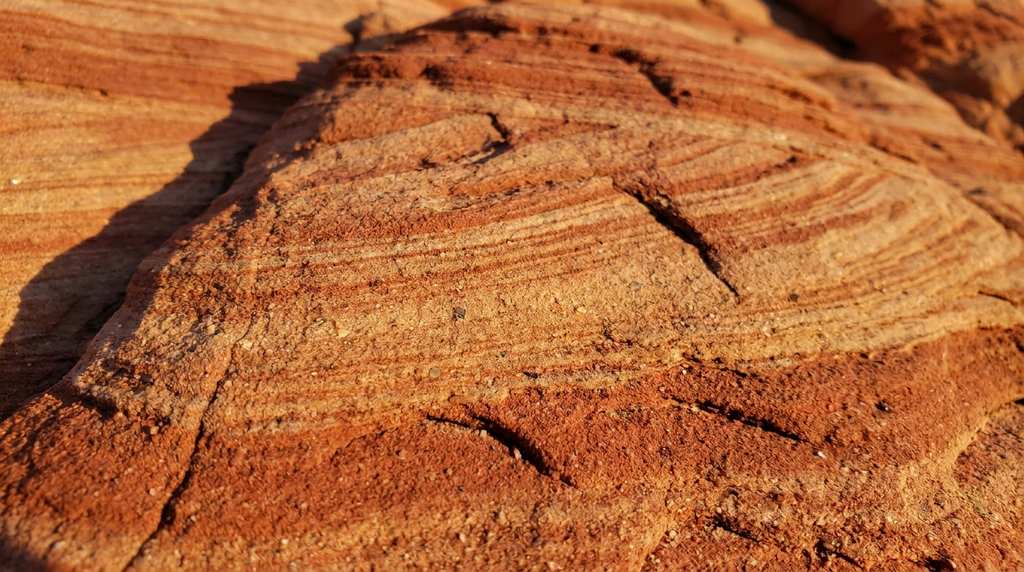
Western Colorado sits on the Colorado Plateau, a vast uplift of sedimentary rock that happens to be unusually rich in uranium. Two features matter most for radon here. The first is the Morrison Formation, a Jurassic-age rock layer that carries uranium-bearing minerals such as carnotite. The second is the Uravan Mineral Belt, an arc of uranium and vanadium deposits running through southwestern Colorado and southeastern Utah that made this region one of the most important uranium-mining areas in American history.
The chain from rock to indoor air is direct:
Because the source is the ground itself, a home's age, price, or condition doesn't protect it — a brand-new build and a century-old house on the same street can both test high.
This is why the EPA places Mesa County in Radon Zone 1, the highest of its three zones, defined by a predicted average indoor screening level above 4.0 pCi/L. It isn't a scare label; it's a map of where the rock produces the most radon.
Grand Junction carries a chapter of history that few American cities share, and it's the reason this community has taken radiation seriously for longer than almost anywhere else. From roughly 1950 to 1970, the Climax Uranium Mill operated on the bank of the Colorado River in Grand Junction, processing ore into uranium during the Cold War era. Milling left behind large quantities of sandy leftover material called tailings.
In those years, before the health implications were understood, the mill gave away and sold that tailings sand, and it was widely used around town as cheap construction fill and aggregate — under and around homes, schools, sidewalks, and other structures at more than 4,000 properties. Tailings contain radium, and radium decay produces radon. In 1966, elevated radiation was identified in structures built on or over this material, which set in motion one of the most extensive residential radiation cleanups the country has ever undertaken.
The response was the federal Grand Junction Remedial Action Program, carried out under the broader Uranium Mill Tailings Remedial Action (UMTRA) effort authorized by Congress. Under the program, contaminated material was located and removed from affected properties — ultimately about 4,266 properties remediated, the most of any UMTRA community — and the tailings were relocated to an engineered disposal cell built for long-term containment. The cleanup of the former processing site was completed by 1997. Records and oversight of this work are maintained by the U.S. Department of Energy's Office of Legacy Management, with the Colorado Department of Public Health and Environment (CDPHE) involved on the state side.
It's important to be precise about what this history does and doesn't mean. The tailings episode is a historical event that was identified and addressed decades ago. The high radon most Grand Valley homeowners see today is not leftover tailings — it's the natural Colorado Plateau geology described above, present under every neighborhood whether or not tailings were ever near it. What the tailings history did leave behind is a legacy of awareness: Grand Junction learned early, and firsthand, that the ground here can carry radiation, and that testing and remediation work. That civic memory is a good thing. It's why local buyers, sellers, and agents tend to ask about radon as a matter of course — and why getting your own home tested is simply the normal, responsible step here.
The reason any of this matters is health, and here the science is settled and worth stating without drama. According to the EPA and CDPHE, radon is the second-leading cause of lung cancer overall and the leading cause among people who have never smoked. CDPHE attributes roughly 500 Colorado lung-cancer deaths per year to radon. The mechanism is straightforward: when you breathe radon, its radioactive decay products can lodge in lung tissue and, over years of exposure, damage the cells there. The risk grows with both the concentration and the length of exposure, which is why the EPA frames mitigation as a long-term protective measure rather than an emergency.
Statewide, CDPHE reports that about half of Colorado homes test above the EPA action level of 4.0 pCi/L. In Mesa County specifically, the state's testing data shows a median result around 2.7 pCi/L, with roughly a third of tested homes at or above 4.0 pCi/L. In other words: many local homes are fine, and a substantial share are not — and there is no way to tell which is which by looking. Radon gives no sign of its presence, so a home that feels perfectly healthy can carry an elevated level for years unnoticed.
Everything above leads to one practical conclusion: in the Grand Valley, testing is the only way to know, and it's inexpensive and easy relative to what's at stake. Zone maps, county medians, and even a neighbor's result can't tell you what's happening in your house, because radon depends on your specific soil, foundation, construction, and how your home moves air. Two houses next door to each other can differ widely.
A short-term test runs a minimum of 48 hours; a longer test gives an even better picture of your year-round average. If your result comes back at or above 4.0 pCi/L, the fix is a well-understood, guaranteed one — an active sub-slab depressurization system that vents the gas safely above the roof — and it's confirmed with a post-mitigation verification test so you know the number actually came down. Colorado now licenses radon measurement and mitigation professionals through the state's Division of Professions and Occupations, so you can choose a licensed local pro with confidence.
If you're ready to find out where your home stands, start with radon testing in Grand Junction, or read about our radon mitigation systems and how they work. The history of this valley is one of learning about radiation and doing something about it — testing your own home is simply the modern, easy version of that same responsible habit.
The geology under the Grand Valley is real, but your home's number is specific to your home — and it's easy to find out. We'll test it, explain it, and fix it if needed.
(970) 639-7503Geology. The Grand Valley sits on the uranium-bearing rock of the Colorado Plateau, including the Morrison Formation and the Uravan Mineral Belt. Uranium in that rock and soil decays into radium and then into radon gas, which seeps up into buildings. That's why the EPA places Mesa County in Radon Zone 1, its highest zone, and why CDPHE test data shows roughly a third of local homes at or above the 4.0 pCi/L action level. The gas comes from the ground itself, so almost any home here can be affected regardless of age or condition.
The two are connected historically but distinct. Grand Junction's high radon is fundamentally geological — it comes from natural uranium in the Colorado Plateau soil under every neighborhood. Separately, in the 1950s and 60s tailings from the Climax Uranium Mill were given away and used as construction fill at thousands of local properties, and radium in that material can produce radon; the federal Grand Junction Remedial Action Program removed tailings from those properties, with the processing-site cleanup completed by 1997. That history is why the Grand Valley has been radiation-aware for decades, but today's elevated radon in most homes is driven by the natural geology, not leftover tailings. The only way to know your home's level is to test it.
The EPA sets an action level of 4.0 pCi/L: at or above that, the EPA recommends fixing the home. Between 2.0 and 4.0 pCi/L, the EPA suggests you consider mitigating, because there is no completely risk-free level — the risk simply rises with the concentration and the years of exposure. There isn't a single number that is instantly harmful; radon is a long-term exposure risk. The practical takeaway is to test, and if you're at or above 4.0, mitigate.
The established health risk from radon is lung cancer. According to the EPA and CDPHE, radon is the second-leading cause of lung cancer overall and the leading cause among people who have never smoked, and CDPHE attributes roughly 500 Colorado lung-cancer deaths a year to radon. It works by decaying into particles you inhale that damage lung tissue over time. Radon is not linked to the kind of immediate symptoms people sometimes assume — you can't smell it or feel it — which is exactly why testing is the only way to know your exposure.